


A fault occurs. The relay correctly detects it and sends a trip command to the breaker... and.... the breaker doesn't open...
This is exactly the condition Breaker Failure Protection, BF or 50BF, is designed for.
It is a scheme you hope never operates. But if it does, it must operate correctly, decisively, and without delay.
So what is the objective of 50BF?
If the primary breaker fails to interrupt current, the protection system must quickly trip surrounding breakers to isolate the faulted element and limit system impact.
How does the relay determine that the breaker has failed?
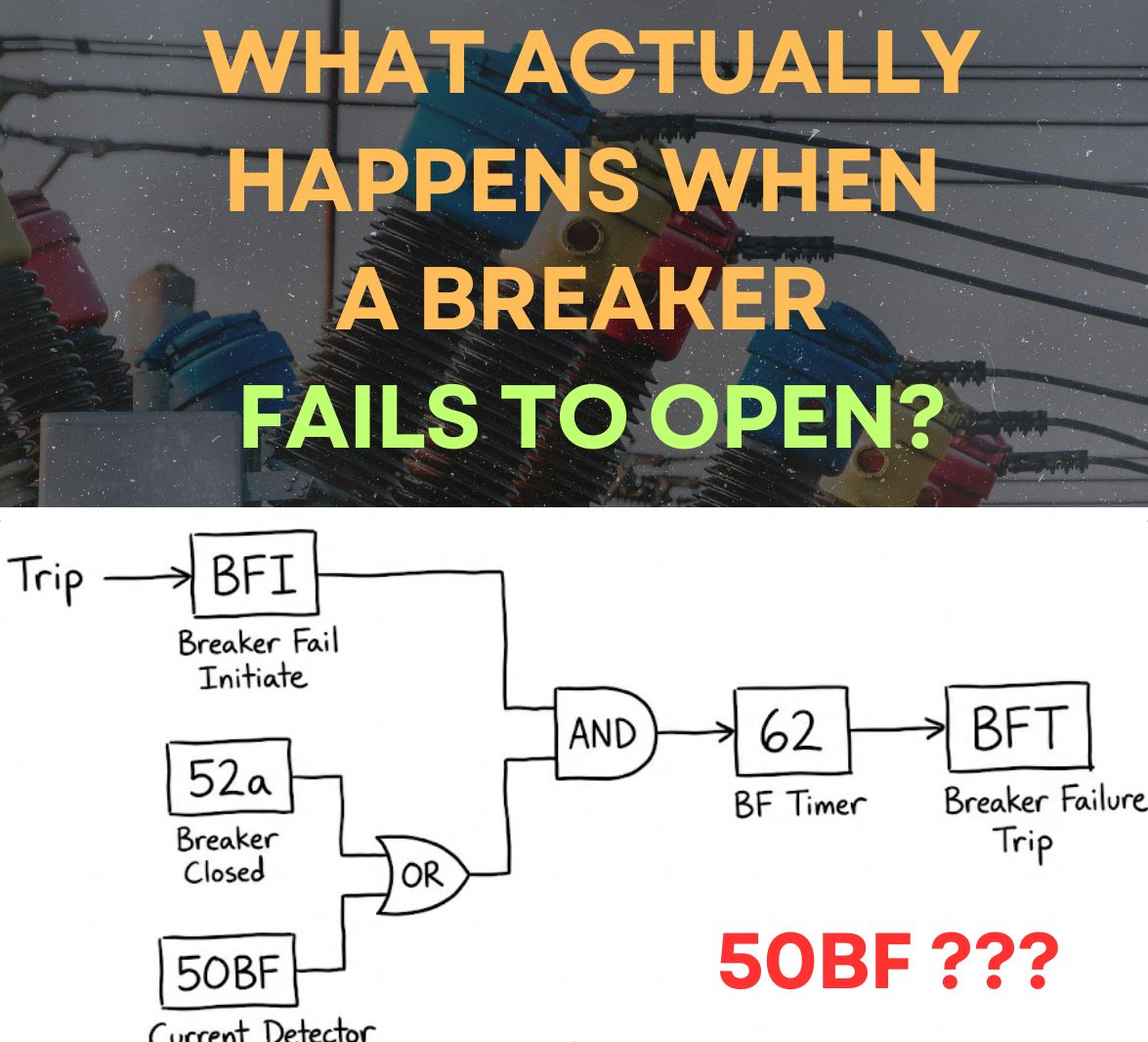
At its core, a breaker failure scheme relies on three fundamental inputs.
- BFI, Breaker Failure Initiate: Derived from a valid trip output of the primary protection element. This arms the breaker failure logic.
- 52a auxiliary contact : Provides mechanical status feedback. If 52a remains asserted, the breaker is still physically closed.
- Current detection, 50BF : Verifies whether current is still flowing through the breaker after a trip command has been issued.
The logic itself is simple but intentional.
If the breaker remains closed, or if current continues to flow, despite a valid trip command, the relay concludes that the breaker has failed to clear the fault.
This is typically implemented as:
- An OR condition checking breaker position or current presence
- Supervised by an AND condition requiring a valid trip request
Once this condition is met, timing becomes the final discriminator.
- 62 timer: The breaker is given a short clearing window, typically on the order of 5 to 12 cycles, depending on breaker speed, relay processing time, and coordination philosophy.
- BFT, Breaker Failure Trip: If the timer expires and the failure condition persists, the relay issues trip commands to upstream or adjacent breakers to isolate the faulted zone.
Most of the time, this logic sits there, quiet, in the background. When it operates, it becomes the last protective barrier between a single breaker malfunction and a much larger system disturbance.
In real installations, breaker failure schemes can be far more involved. Bus configurations, multiple breakers, dual trip coils, redundant status inputs, CT supervision, and communication-assisted logic all add layers of complexity.
But the logic described above is the backbone. If this foundation is wrong, no amount of added sophistication will save the scheme.
For those working in substations or protection engineering:
- Have you ever had to troubleshoot or tune a breaker failure scheme under tight outage or commissioning constraints? What was the hardest part to get right?
If this post is useful, add your experience in the comments or share it with your network or with someone who is learning to design, commission, or troubleshoot 50BF in the field!