



In medium-voltage power distribution retrofit projects, most people focus primarily on replacing circuit breakers, renovating cabinet structures, and enhancing the visual appearance. It is widely assumed that as long as the circuit breakers are replaced and the switches can open and close and supply power, the retrofit is considered successfully completed.
However, after working in the industry for many years and engaging with hundreds of on-site retrofit projects, we have found that the latent faults in the vast majority of circuit breakers after retrofitting are not caused by any issue with the switch itself; rather, they result from mismatched relay protection, unupdated parameters, or incompatible circuits.
The switch is merely an "actuator"; relay protection is the safety brain of the entire power distribution system.
Replacing only the circuit breaker while failing to optimize the protection may appear cost-effective and convenient, but it can easily lead to numerous problems in the later stages:
✅ Faults fail to trip or fail to operate, resulting in equipment burnout and busbar short circuits.
✅ False tripping and frequent false operations impair continuous production
✅ Mismatched parameters between legacy and new equipment result in inconsistent protection logic
✅ No signal on the backend and abnormal alerts make it impossible for operations staff to anticipate risks
In today's practical guide, we will take a practical, implementation-oriented perspective and clarify the following: when upgrading medium-voltage circuit breakers, there is no need to overthink the details of the switch itself; however, you must pay close attention to the key aspects of the accompanying relay-protection upgrades.
I. Circuit breaker retrofitting: 90% of field installations have encountered these protection-side issues
In many retrofits of aging switchgear cabinets, the circuit breaker model has been updated, and mechanical parameters and opening/closing characteristics have changed; however, the relay protection devices, setting values, and secondary circuits have been retained in their original configurations. This constitutes the most significant safety hazard.
1. Protection setting mismatch with the performance of the new circuit breaker
Outdated circuit breakers have slow opening and closing speeds and limited breaking capacity; the existing protection settings are compatible with the older equipment.
After replacing the circuit breaker with a brand-new unit, the equipment's circuit-breaking performance and response speed improve significantly; if the outdated settings are still retained:
-Set value too high: faults cannot be cleared promptly, causing the new circuit breaker and downstream equipment to burn out
-Set value too low: trips occur even with minor load fluctuations, resulting in extremely poor power supply stability.
Core modification: After the circuit breaker has been upgraded, the protection settings must be re-verified and readjusted to align the performance of the new equipment with the on-site load.
2. Incompatible secondary-circuit logic resulting in protection signal failure
There are differences in the auxiliary contacts, opening/closing coil parameters, and signal feedback logic between the old and new circuit breakers.
Many on-site installations perform only basic wiring without verifying the circuit definitions, making it highly likely that the following problems will arise:
-Protects against the issuance of a trip command, preventing the circuit breaker from operating
-The circuit breaker is in an abnormal state; there are no alarms or uploaded signals on the backend.
-Failure of the five-prevention interlocks and electrical interlock logic creates a risk of erroneous operation
3. Outdated protection devices have outdated performance and are unable to support new equipment.
In many plant facilities, circuit breakers are replaced frequently; protection devices are operating beyond their service life, hardware has aged, and software versions are outdated.
The precise switching requirements of modern circuit breakers place higher demands on protection system response speed, sampling accuracy, and fault discrimination capability. Legacy protection devices lack sufficient accuracy and have poor interference immunity, making them incompatible with new switches and thereby severely reducing the overall safety margin of the entire power distribution system.
4. As intelligent upgrades are implemented out of sync, O&M complexity doubles
Today, both new and retrofitted power distribution rooms are increasingly moving toward intelligent operation; new-generation circuit breakers support remote signaling, status monitoring, and data upload.
If a circuit breaker is upgraded to a smart version while the associated protection devices are not updated accordingly, the result will be "smart equipment but an outdated control system," making it impossible to achieve remote monitoring, fault tracing, and intelligent early warning, thereby wasting the performance of the new equipment.
II. Upgrading supporting services: With relay protection as the core, providing a one-stop implementation solution
After many circuit breaker retrofit projects are completed, problems such as frequent false tripping, failure to operate during faults, and disordered back-end signaling frequently occur. These issues are not caused by quality problems with the circuit breakers themselves, but rather by inadequate supporting retrofits for relay protection and the lack of compatibility and proper integration between the old and new systems. Replacing primary equipment is only the foundation; the synchronized verification, integration, and commissioning of the relay protection system are the key factors determining whether the power distribution system can operate safely, stably, and accurately after the retrofit. Drawing on practical field experience, we have compiled the essential practical guidelines for implementing supporting relay protection during circuit breaker retrofitting; these also constitute the standard procedures that must be implemented in every electrical retrofit project.
🔥 Key Insight 1: Systematic Review of Protection Setpoints
After the circuit breaker is replaced, the equipment's fault-clearing capacity, operating response time, and load-bearing parameters all change; consequently, the existing protection settings are no longer suitable for the new equipment. During the retrofit, a comprehensive verification of the protection settings for the entire substation must be carried out simultaneously. Based on the technical parameters of the new circuit breaker, the actual on-site load capacity, and the system's short-circuit current data, the core protection settings—including overcurrent, instantaneous, zero-sequence, and overload protection—must be readjusted. At the same time, a tiered coordination of protection settings between upstream and downstream levels should be implemented to avoid common issues such as upstream tripping due to downstream faults, failure to accurately isolate faults, and frequent false operations; this ensures the selectivity, sensitivity, and reliability of protection operations.
🔥 Core Insight 2: Verification of the Secondary Circuit and Protection Logic
The definitions of auxiliary contacts for new and existing circuit breakers, the voltages in the opening and closing circuits, and the signal feedback logic differ from one another; this is the primary cause of signal abnormalities and lockout failures after the retrofit. During the construction phase, secondary wiring must be verified item by item, and the circuit definitions for the circuit-breaker position signal, trip signal, energy-storage signal, and alarm signal must be calibrated, while the internal logic programs of the protection devices must be matched accordingly. Particular emphasis should be placed on verifying the electrical locking logic, the five-protection interlocking logic, and the remote/local control logic, ensuring that the entire closed-loop process—from protection command issuance to circuit-breaker actuation and back-end signal upload—remains effective and eliminating potential risks such as logic conflicts, signal loss, and command failures.
🔥 Core Insight 3: Condition Monitoring for Equipment Protection
Replacing a new circuit breaker does not necessarily require replacing the associated protection device; however, aging protection equipment must undergo a comprehensive condition assessment. For protection devices that have exceeded their service life, use outdated software versions, exhibit degraded sampling accuracy, or have insufficient anti-interference capability, targeted software upgrades, circuit modifications, and module verification should be carried out; if the hardware performance of the equipment cannot match the operating accuracy and response speed of the new circuit breaker, the protection equipment should be upgraded promptly. This ensures that the sampling frequency, fault discrimination speed, and output contact capacity of the protection device are fully compatible with the new primary equipment, thereby eliminating performance deficiencies caused by the combination of "new equipment + outdated protection."
🔥 Key Insight 4: Intelligent Communication Coordination and Full-Website Point-to-Point Debugging
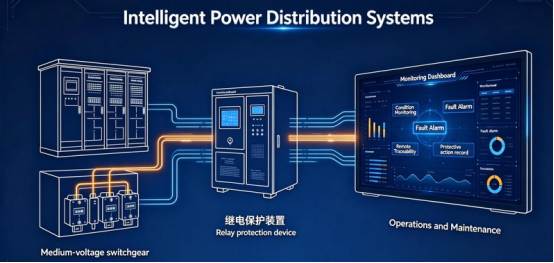
At this stage, most power distribution retrofits involve intelligent upgrades; new circuit breakers generally support real-time status monitoring, fault recording, and remote control functions. In the later phase of the retrofit, it is necessary to complete communication and coordination commissioning between protection devices, circuit breakers, the power backend, and the measurement and control system; unify communication protocols; calibrate data points; and complete full-scope signal point-to-point verification. This enables the real-time upload of circuit breaker operating status, fault information, temperature rise data, and opening/closing records, ensuring that the operations and maintenance side can accurately monitor equipment conditions and rapidly trace faults, thereby fully realizing the value of intelligent retrofitting.
Final Thoughts
When upgrading a circuit breaker, the equipment is replaced, while relay protection provides the safety net.
Do not treat what appears to be a simple "replacement and retrofit" as such; if the protection system is mismatched or the parameters are inadequate, it can create long-term hidden risks to power distribution safety.