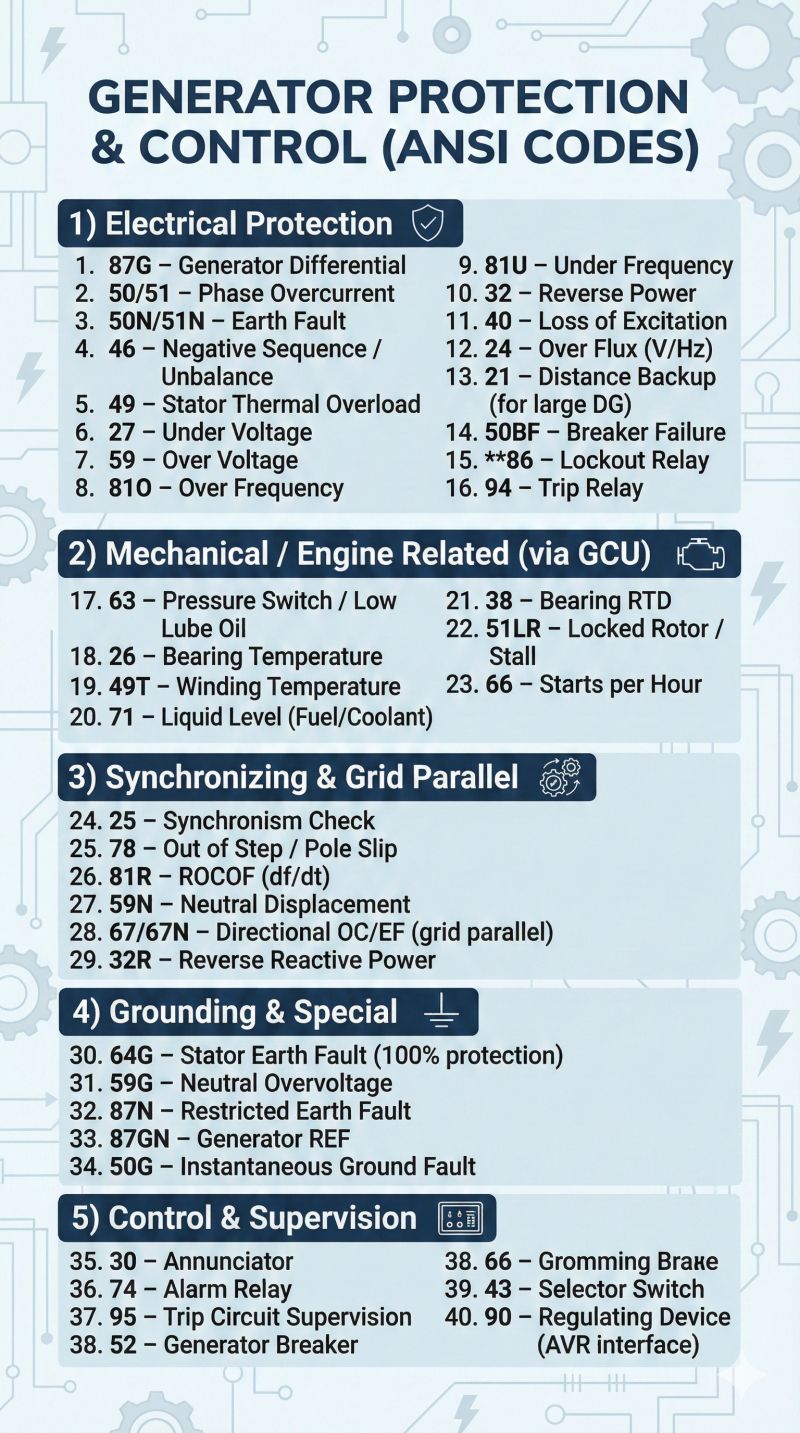



Generator Protection & Control⚡️
1. Electrical Protection Layer 🛡️
• This is the main nervous system of a DG set.
• 87G Differential gives ultra-fast internal winding fault clearance.
• 50/51 & 50N/51N cover external short circuits on phase and earth.
• 46 Negative Sequence protects rotor from heating due to load unbalance.
• 27/59 Voltage & 81O/U Frequency keep the machine inside AVR & governor limits.
• 32 Reverse Power stops motoring action when the prime mover fails.
• 40 Loss of Excitation avoids pole slip in synchronous generators.
• 24 V/Hz prevents core over-fluxing during start or AVR malfunction.
• 50BF + 86 Lockout ensure dependable isolation even if breaker refuses to trip.
2. Mechanical / Engine Interface (via GCU) 🔧
• A generator is half electrical, half engine.
• 63 oil pressure, 26/38 temperature, 71 level watch prime mover health.
• 51LR locked rotor limits starting stress.
• 66 starts/hr respects manufacturer duty cycle.
• These signals combine with electrical trips for total machine safety.
3. Synchronizing & Grid Parallel 🌐
• Parallel operation needs system-level intelligence.
• 25 Sync Check matches voltage, frequency & phase before closing.
• 78 Pole Slip detects loss of synchronism.
• 81R ROCOF & 59N meet grid code requirements.
• 67/67N Directional identifies fault direction with multiple sources.
• 32R controls unwanted reactive power flow.
4. Grounding & 100% Stator Coverage ⚙️
• Normal OC cannot see faults near neutral.
• 64G / 59G detect neutral displacement.
• 87N/87GN REF provide sensitive internal earth fault protection.
• 50G acts as instantaneous backup for severe faults.
5. Control & Supervision 👁️
• Protection must be supervised continuously.
• 95 TCS proves trip coil integrity.
• 30/74 annunciation gives operator visibility.
• 52 breaker & 43 selector integrate with AMF/SCADA.
• 90 AVR interface links excitation with protection logic.